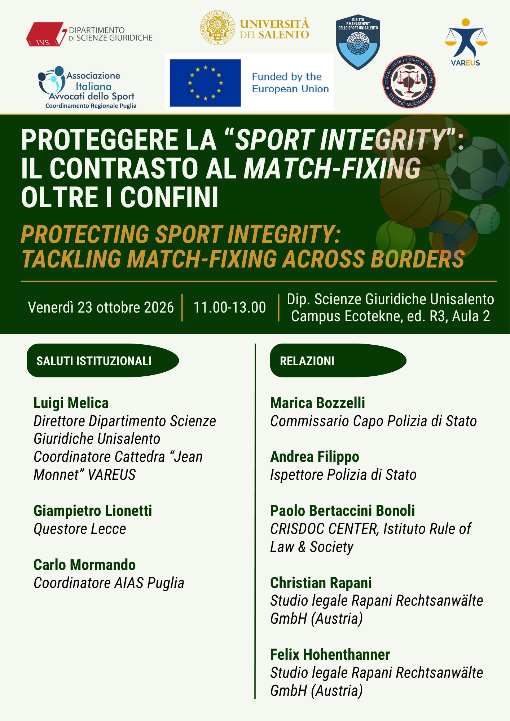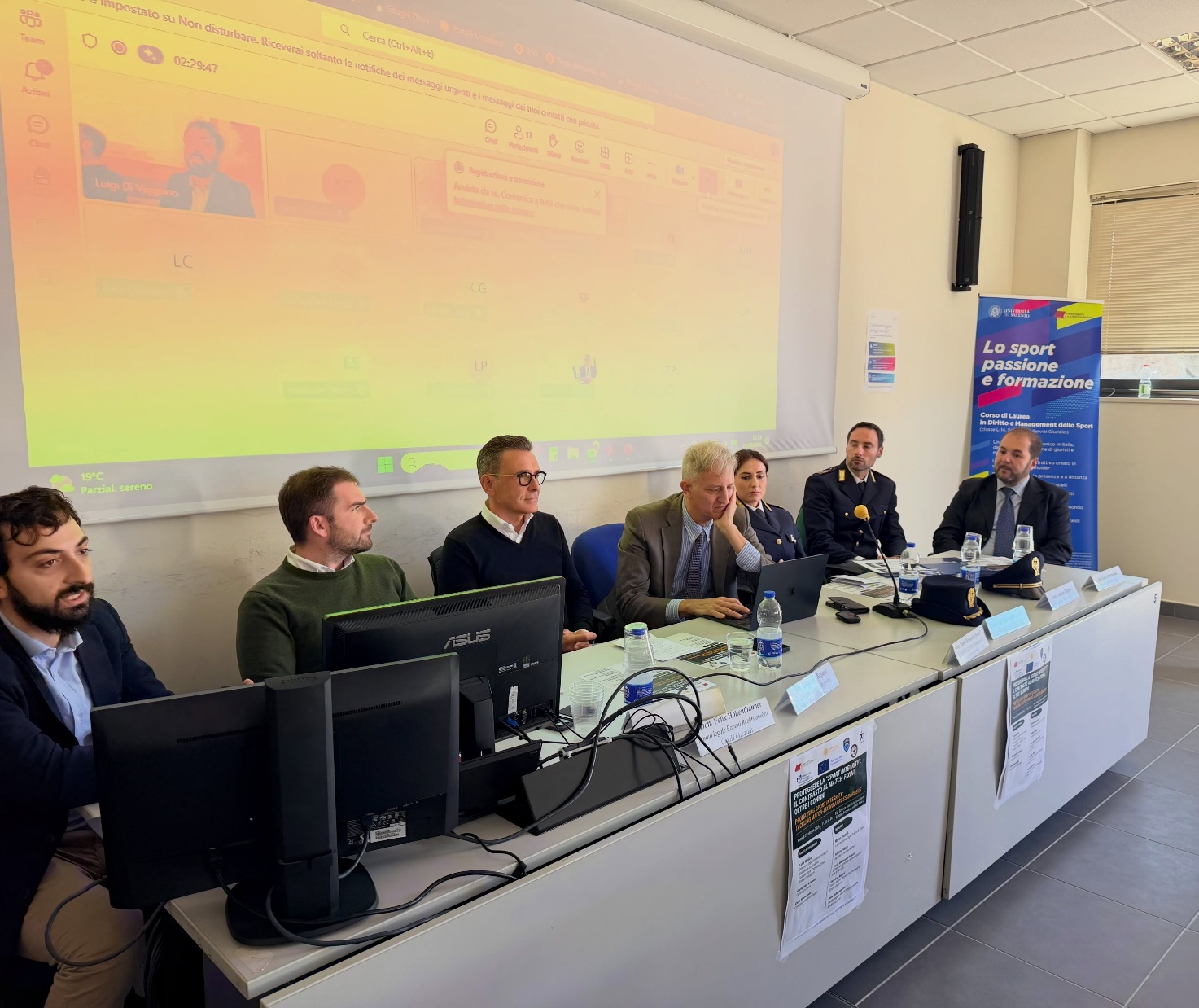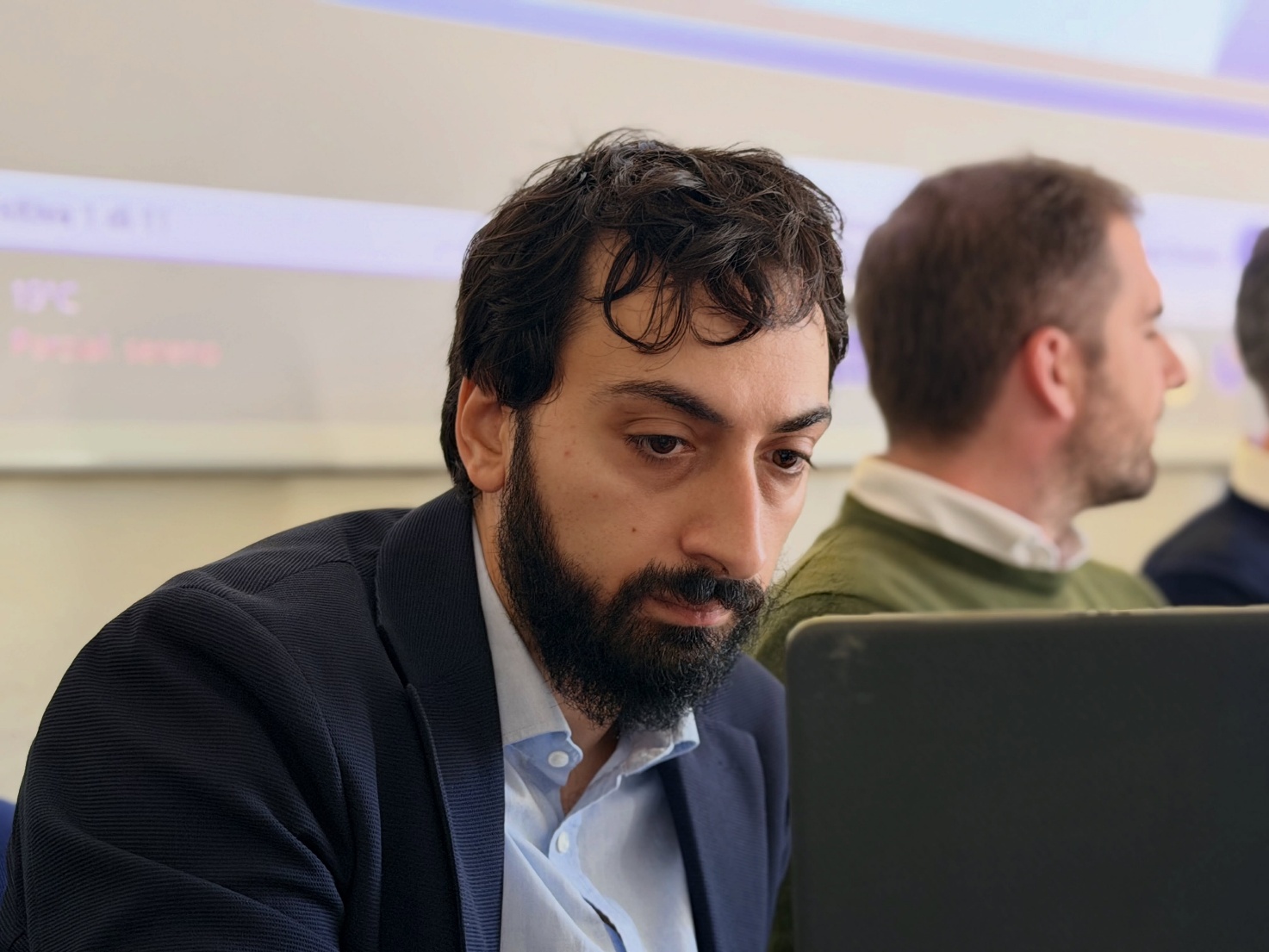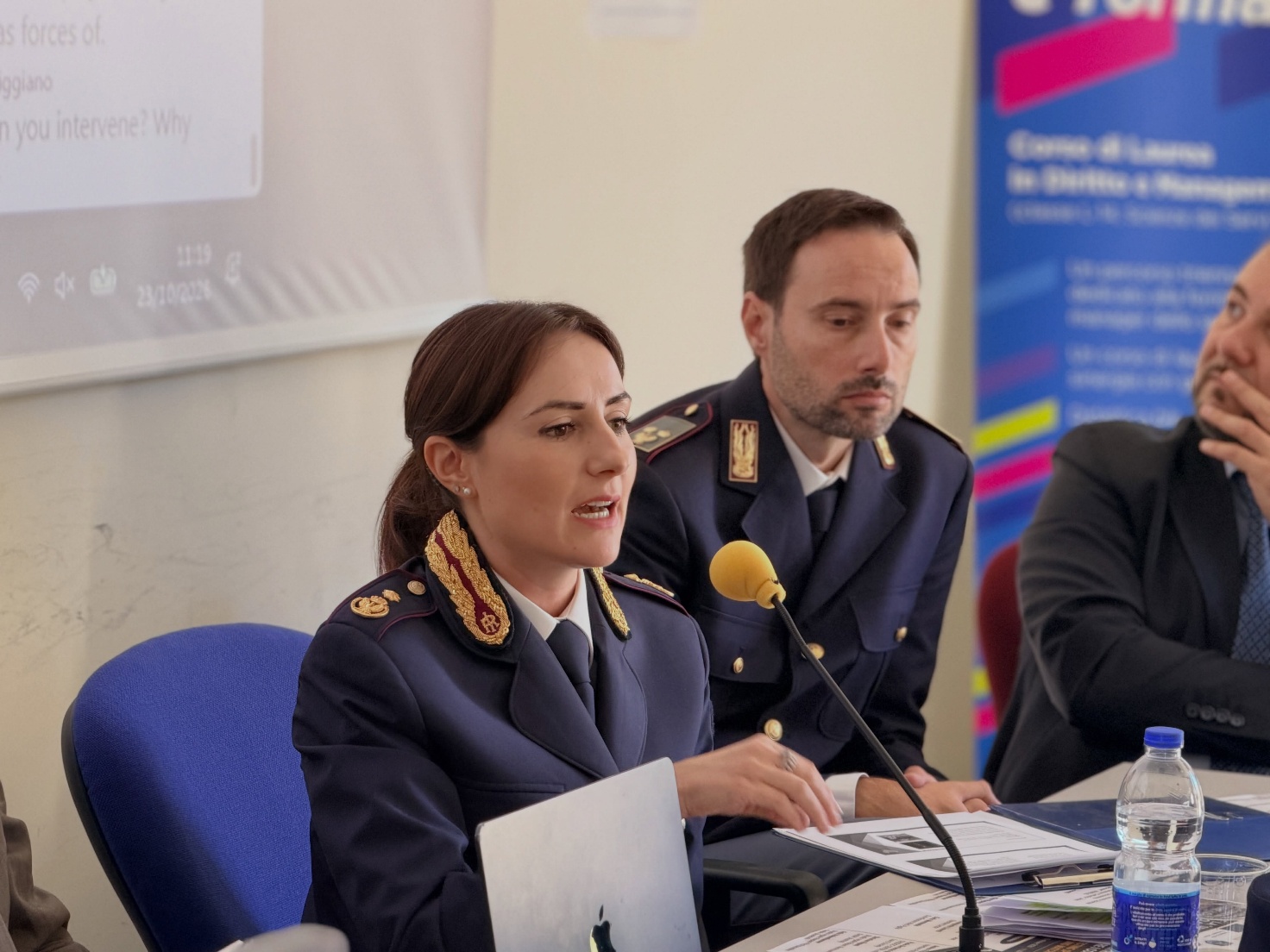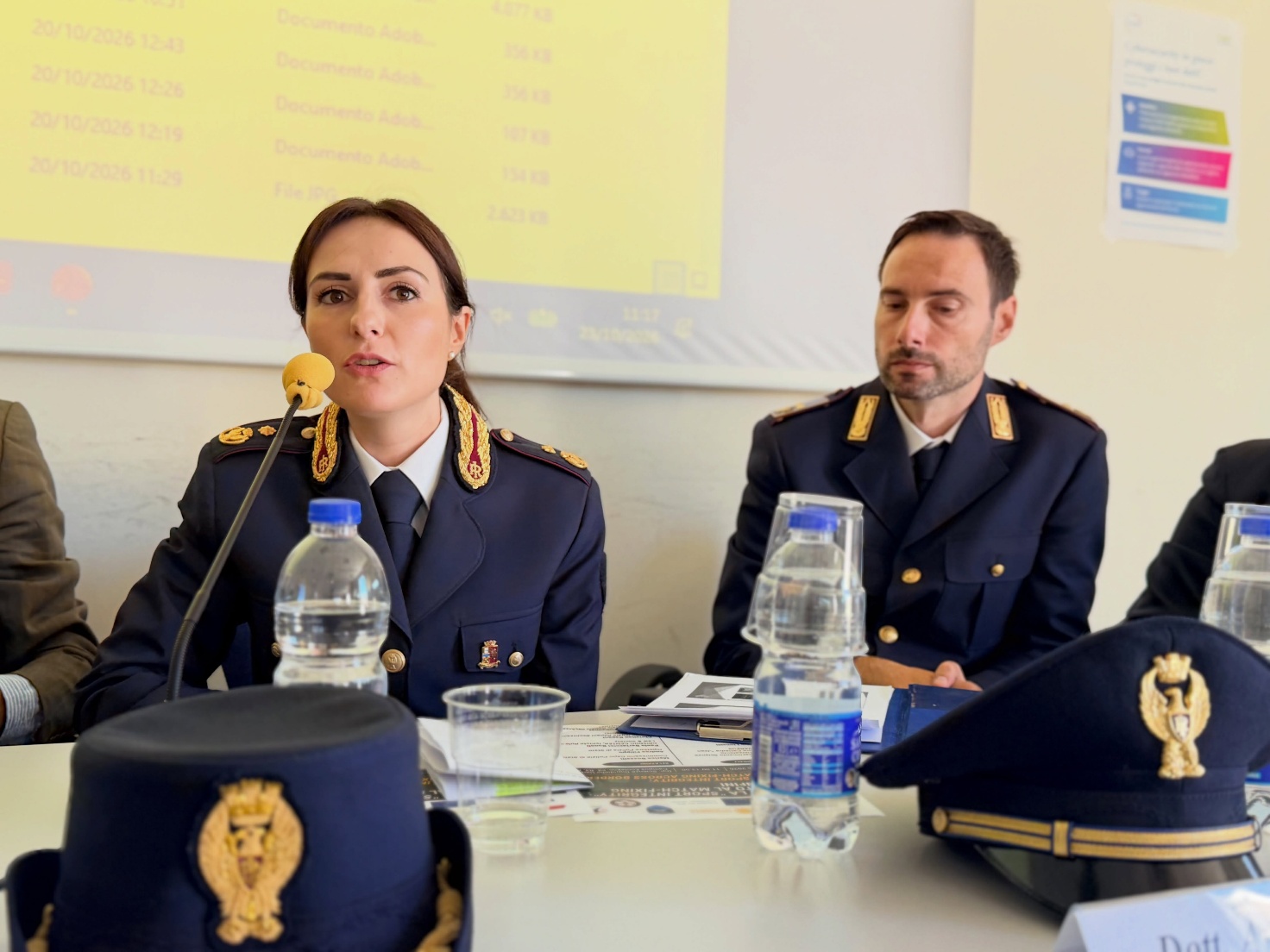
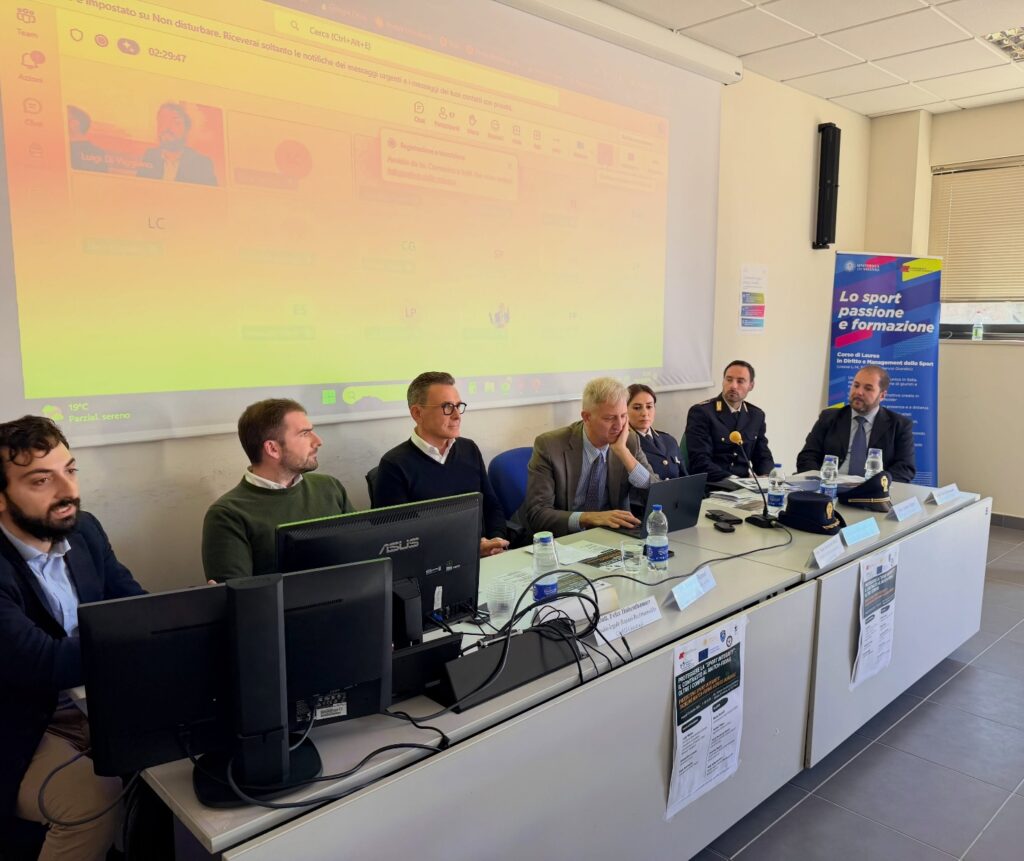
On 23 October 2026, the University of Salento’s Department of Legal Sciences hosted “Protecting Sport Integrity: Tackling Match-Fixing Across Borders”, a seminar on the manipulation of sporting competitions and ways to prevent and counter it. The event attracted 30 participants, including students and law-enforcement officers.
It was organised as part of the Jean Monnet Chair VAREUS – Values, Autonomy and Rule of Law in European Sport, in cooperation with the Sports Law and Management degree programme, the Apulia regional branch of the Italian Association of Sports Lawyers and the “Vittorio Mormando” Centre for Sports Law Studies.
Italian and Austrian experts discussed the issue from legal, investigative and cross-border perspectives, examining criminal and sports law, law enforcement, international cooperation and the part played by betting operators in identifying unlawful conduct.
Prevention, investigation and safeguarding sporting integrity
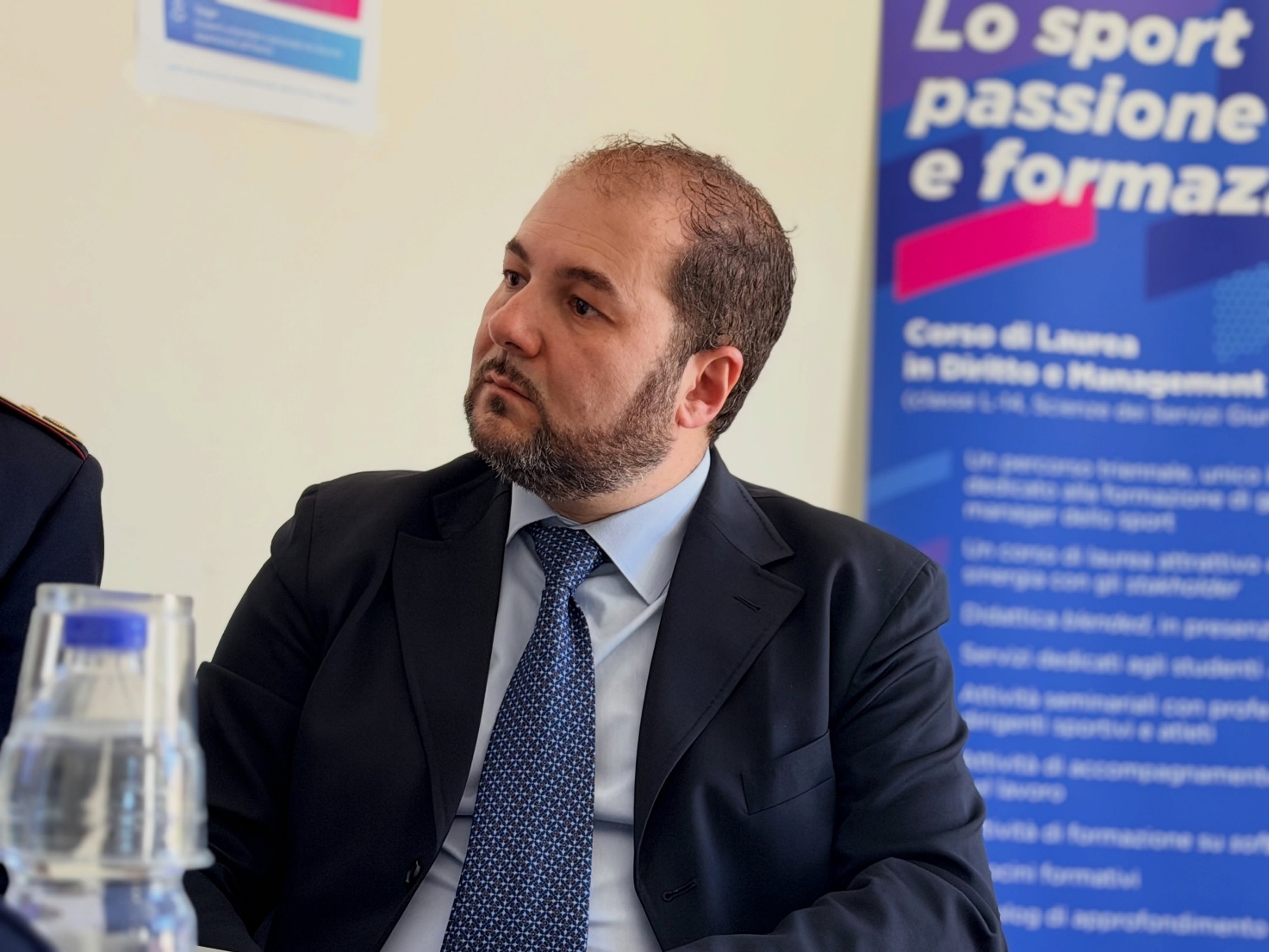
Alberto Orlando, a researcher in Comparative Public Law at the University of Salento, opened the meeting by emphasising the need for cooperation between public authorities, sports organisations and private stakeholders. Carlo Mormando, regional coordinator of the Italian Association of Sports Lawyers, stressed the importance of protecting competitions from economic and criminal interests surrounding sport.
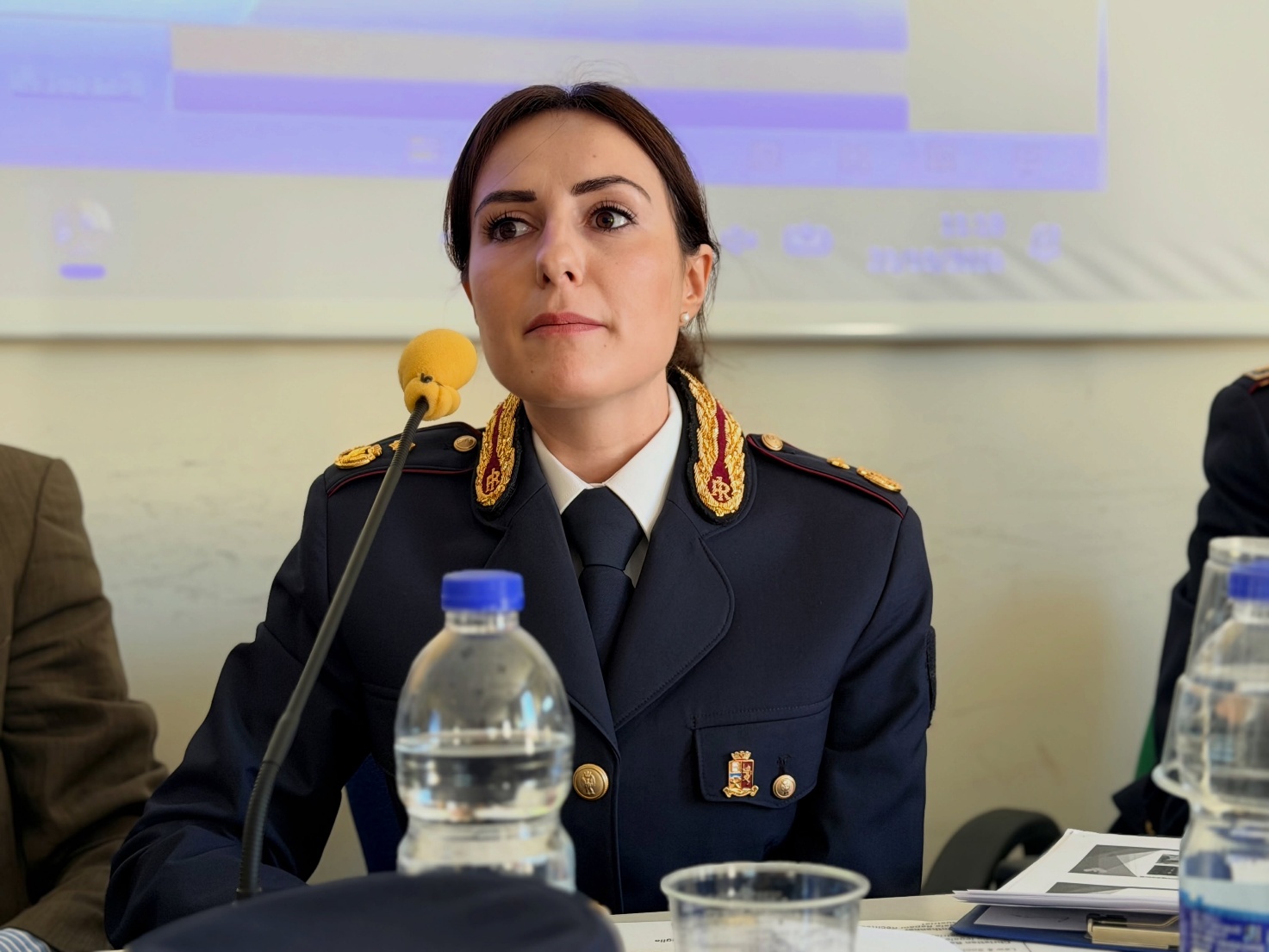
Marica Bozzelli, Chief Commissioner of the Italian State Police, also conveyed greetings from Lecce Police Chief Giampietro Lionetti. She outlined work in monitoring, investigation and prevention, highlighting information-sharing between authorities and sporting institutions and the need to educate athletes, referees and officials.
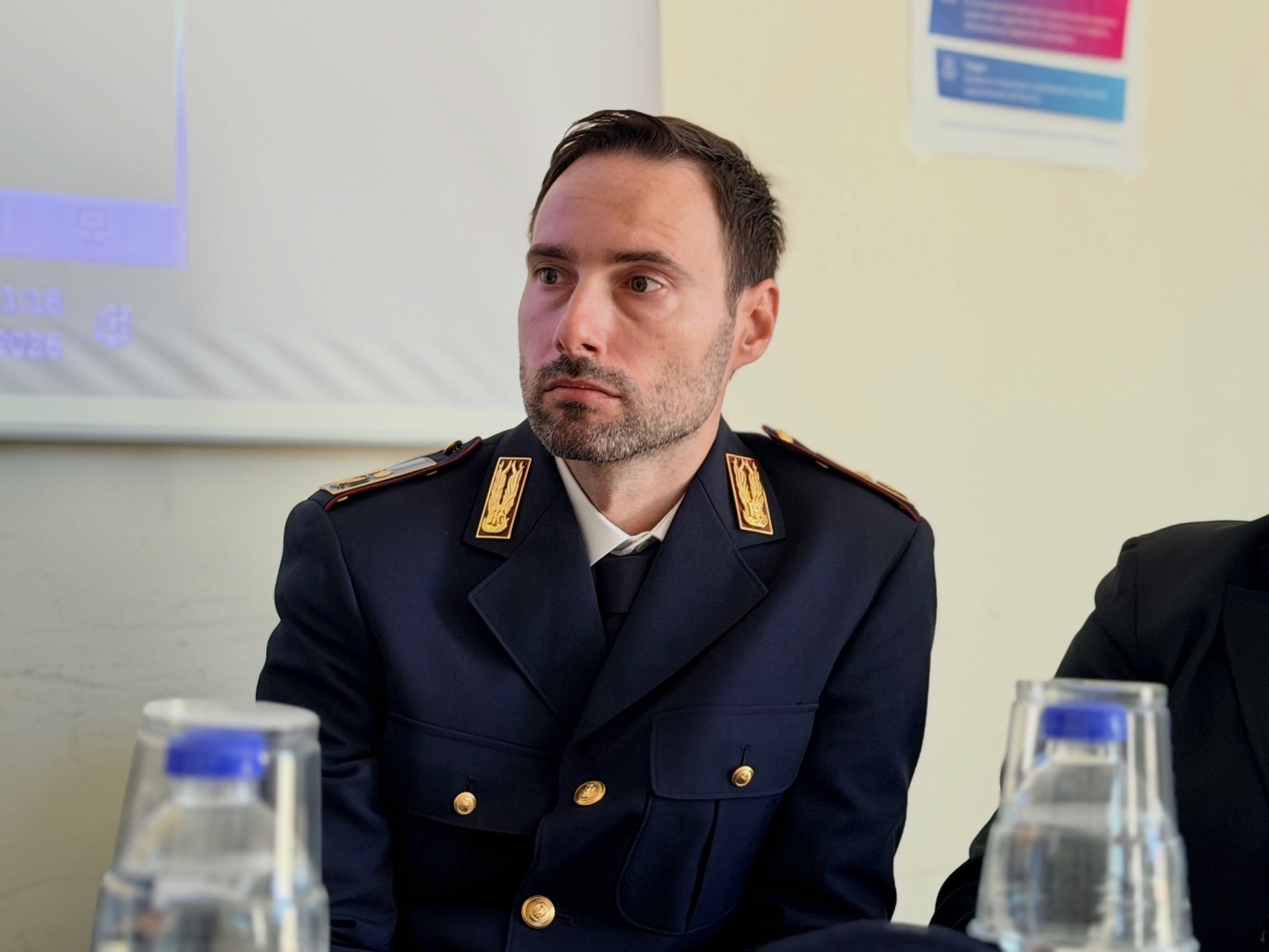
State Police Inspector Andrea Filippo distinguished match-fixing from spot-fixing, examined the Italian criminal-law framework and explored links with gambling, money laundering and organised crime. He also discussed tools for detecting irregular betting patterns and the transition from intelligence analysis to field investigations.
Cross-border cooperation and the role of betting operators
Paolo Bertaccini Bonoli of CRISDOC CENTER – Institute for Rule of Law & Society placed match-fixing within the wider context of criminal infiltration of sport, including money laundering, economic penetration and attempts to gain social legitimacy.
Simone Farina joined by telephone to describe his experience of reporting an attempted match-fixing approach. His contribution highlighted prevention, education from youth level and effective protection for those who report wrongdoing.
The final session was delivered by Christian Rapani and Felix Hohenthanner of the Austrian law firm Rapani Rechtsanwälte GmbH. Using examples from football and tennis, they explained the Austrian regulatory framework and warning signs of possible manipulation: unexplained betting-odds movements, sudden shifts in betting behaviour and unusually large wagers on specific events.
Football, tennis and betting markets: questions from participants
The discussion highlighted how individual sports such as tennis can be particularly vulnerable, since manipulation may depend on the actions of a single athlete. Football nevertheless faces considerable exposure because of the sheer number of matches and betting markets.
One case concerning third-tier Austrian football illustrated the financial imbalance between payments to participating players, reportedly just a few hundred euros per match, and the overall losses incurred by betting operators, estimated at approximately €200,000.
Regarding tennis, speakers explained that detecting manipulation usually goes beyond assessing on-court performance: movements in odds, unusual concentrations of wagers and changes in account behaviour can be key warning signs. Participants also discussed restricting the types of betting particularly vulnerable to manipulation, such as markets on isolated incidents during a match.
The seminar demonstrated the need for an integrated response combining prevention, investigation, sports regulation, data analysis and international cooperation, in line with the VAREUS Chair’s commitment to sporting autonomy, integrity and the rule of law across Europe.
Seminar poster and photographs