

Project overview
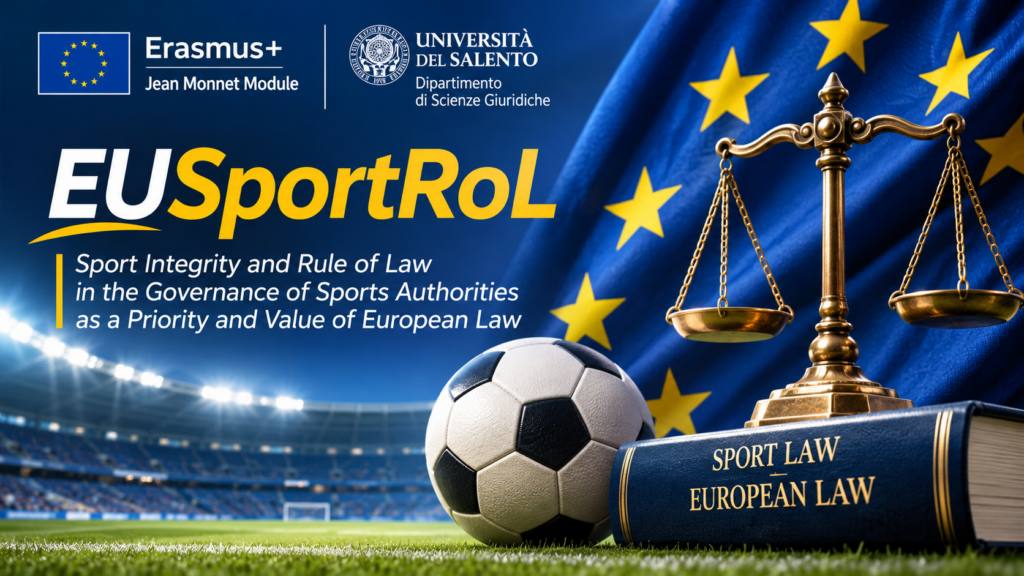
EUSportRoL – Sport Integrity and Rule of Law in the Governance of Sports Authorities as a Priority and Value of European Law was an Erasmus+ Jean Monnet Module delivered by the University of Salento’s Department of Legal Sciences, with funding from the European Commission. It ran from 1 October 2022 to 30 September 2025 under the scientific coordination of Luigi Melica.
Key information
- Title: Sport Integrity and Rule of Law in the Governance of Sports Authorities as a Priority and Value of European Law
- Acronym: EUSportRoL
- Programme: Erasmus+ Jean Monnet Module
- Call: ERASMUS-JMO-2022-HEI-TCH-RSCH
- Funding instrument: ERASMUS-LS
- Project code: 101085327
- CUP: F81I22002000006
- Beneficiary: University of Salento, Department of Legal Sciences
- Scientific coordinator: Luigi Melica
- Duration: 1 October 2022 – 30 September 2025
- Keywords: Sport integrity; Rule of Law; Sports governance; European sport; Sports policy.
Description and objectives
EUSportRoL examined the evolving relationship between European Union law and the sports legal order, focusing on sporting integrity, the rule of law, sporting autonomy and specificity, and good governance. Its starting point was the need to identify a legal understanding of sporting autonomy capable of guiding European and national institutions, federations, other sporting bodies, clubs and athletes.
The autonomy of sporting organisations was not treated as a sphere outside EU law. The project studied the conditions under which autonomy can be recognised and protected, linking it to EU values, the rule of law and good-governance standards applicable to bodies exercising regulatory and managerial powers.
Sport integrity was understood not merely as the fight against corruption and match-fixing but as a broader principle requiring transparency, accountability, fairness, inclusion and protection of sport’s social and educational role. Integrity can thus become a European value benefiting athletes, sports organisations and society, with particular regard to the inclusion of vulnerable groups.
The project combined comparative legal analysis with an interdisciplinary approach embracing ethical, political, historical, economic and social aspects of sport. Teaching, seminars and research brought together academics, students, practitioners, institutional representatives and sports professionals, allowing theoretical debate to engage with the practical experiences of athletes, coaches and administrators.
Main objectives
- Examine the relationship between EU law and the sports legal order, particularly Article 165 TFEU, sport’s specificity and the limits of sporting organisations’ autonomy.
- Promote the rule of law and good governance in sport, applying legality, transparency, accountability and procedural safeguards to sporting authorities.
- Develop sport integrity as a European value linked to athletes’ rights, inclusion, fair play and sport’s social and educational function.
- Identify strengths and gaps in the existing regulatory framework by comparing EU law, national legal systems and transnational sports regulation.
- Strengthen dialogue between universities and sport, involving European and national institutions, sporting organisations, professionals, students, coaches and athletes.
- Spread a European culture of sporting integrity through lectures, seminars, expert meetings, public engagement and research publications.
Scientific team and contributors to the final volume
Luigi Melica
Scientific coordinator and editor of the final volume. Professor of Comparative Public Law and Director of the Department of Legal Sciences at the University of Salento. He coordinated EUSportRoL and teaches Sport and Cultural Identity in Comparative Law. He has published extensively on comparative constitutional law, European law and sports law, including the monographs Sport e “diritti” in Italia e nel mondo and L’“éclairer” dell’Olimpismo. De Coubertin tra i giganti del metodo comparato.
Ubaldo Villani-Lubelli
Associate Professor of History of Political Institutions at the University of Salento. He chairs the Master’s Degree in Euro-Mediterranean Governance of Migration Policies and teaches subjects including History of European Integration and History of EU Political Institutions. His research covers twentieth-century German political history, European integration and the history of sports institutions.
Mario Luigi Torsello
A former Section President of the Italian Council of State and judge at the Court of Auditors, Torsello teaches Sports Justice at the University of Salento. He has held senior posts at the Prime Minister’s Office and various ministries and chairs the FIGC Federal Court of Appeal and a sports justice body of the Aero Club of Italy. His academic and professional work focuses on the principles of sports law and federal justice systems.
Alberto Orlando
A researcher in Comparative Public Law at the University of Salento, where he teaches Sport and Cultural Identity in Comparative Law. He completed his PhD at the same institution and wrote Ordinamento transnazionale dello sport tra autonomia e modello sportivo europeo, as well as papers on European and transnational sports law.
Paolo Mormando
A Supreme Court-qualified lawyer specialising in sports, civil, commercial, insurance and administrative law. He is an Additional Federal Prosecutor with the functions of Interregional Federal Prosecutor for the FIGC and sits on the Federation’s Youth and School Sector Commission for the Protection of Minors. He also works with the University of Salento’s Sports Justice Chair.
Alessandra Dell’Aquila
Holds a PhD in Rights and Sustainability from the University of Salento, with a thesis on the ESG transition in European football, and a Postgraduate Certificate in Sport Governance from Birkbeck, University of London. She has more than ten years’ experience organising international sporting events, including collaborations with UEFA, Red Bull and RCS Sport.
Emanuela Mirella De Leo
A lawyer specialising in sports law and eSports, an Olympic educator for CONI and a federal judge of the Italian Cycling Federation. She is Secretary-General of the Italian Non-Profit Observatory, an adjunct lecturer at LUM University and an adviser to federations and sports organisations. Her work focuses on digital sports regulation, eSports and competitive gaming.
The project’s scientific outcome
Sport integrity e Rule of law nelle attività sportive: itinerari e prospettive per un modello di sport europeo
The principal final scholarly output of EUSportRoL was the edited volume Sport integrity e Rule of law nelle attività sportive: itinerari e prospettive per un modello di sport europeo, edited by Luigi Melica and published in 2025 by Salento University Publishing in its peer-reviewed Scienze dello Sport series. The complete publication is available open access.
Bibliographic reference: Sport integrity e Rule of law nelle attività sportive: itinerari e prospettive per un modello di sport europeo, edited by Luigi Melica, Scienze dello Sport, no. 2/2025, Salento University Publishing, ISBN 978-88-8305-238-5, DOI 10.1285/i9788883052385v2.
The volume reflects the project’s interdisciplinary character. Contributions address sport, politics and Olympic values; principles of sports law; developments in European case law; the European sports model; safeguarding; sustainability in football; eSports; and artificial intelligence. It relates the theoretical analysis of autonomy and the rule of law to practical issues faced by sports governance bodies.
Contributions
Luigi Melica
“The right to take part in sport as a segment of the right to take part in cultural life. Principi e valori dello sport olimpico a margine della decisione di riammissione degli atleti russi e bielorussi alle Olimpiadi di Parigi del 2024”
This chapter examines the right to participate in sport as an aspect of cultural participation and explores universality, political neutrality, non-discrimination and Olympic values. The readmission of Russian and Belarusian athletes to the Paris 2024 Olympics provides a starting point for examining the difficult balance between sporting sanctions and individual athletes’ rights.
Ubaldo Villani-Lubelli
“Dai boicottaggi statali alle sanzioni istituzionali: l’evoluzione del rapporto tra politica e Olimpiadi”
This essay traces relations between politics and the Olympic movement, from state-led boycotts to sanctions imposed by sporting institutions, showing how the claimed neutrality of sport has continually been challenged by international crises and political conflict.
Mario Luigi Torsello
“Il principio di lealtà nell’ordinamento sportivo”
The contribution studies the principle of loyalty as a fundamental clause of the sporting legal order, its function, its independence from state-law categories and its application by sports justice bodies. It clarifies the relationship between sporting ethics, disciplinary responsibility and rule-of-law safeguards.
Alberto Orlando
“L’ultima stagione del diritto europeo dello sport nella giurisprudenza della Corte di giustizia: la faticosa emersione della specificità”
This chapter follows the development of European sports law from Walrave and Meca-Medina to the Court of Justice’s more recent rulings in TopFit, European Superleague, ISU, Antwerp, Diarra and Seraing. It examines the increasingly rigorous application of EU competition law and economic freedoms, and the difficulties of giving sport’s specificity independent legal significance.
Alberto Orlando
“Il modello sportivo europeo in cerca d’autore”
The essay examines the meaning of the European sports model and the difficulty of defining it as a coherent legal concept. It considers political initiatives, Article 165 TFEU and Court of Justice case law, questioning the model’s capacity to justify particular organisational and solidarity structures in European sport.
Paolo Mormando
“I Modelli Organizzativi e di Controllo (MOC) nel sistema di safeguarding nello sport”
This study examines organisational and control models in Italy’s system for preventing abuse, violence and discrimination in sport, including the responsibilities of clubs, safeguarding officers and the preventive mechanisms introduced by legal reform.
Alessandra Dell’Aquila
“La traiettoria della sostenibilità nel calcio europeo”
The contribution traces economic, social and environmental sustainability in European football and the growing importance of ESG standards, including the responsibilities of football bodies and clubs and the links between sustainability, governance, financial regulation and competitiveness.
Emanuela Mirella De Leo
“ESports e Gaming Competitivo nell’era dell’IA: regime giuridico, tutela dei dati e responsabilità alla luce della normativa italiana e internazionale”
The chapter explores the legal treatment of eSports and competitive gaming in the age of AI, with a focus on personal data protection and the distribution of responsibilities among players, organisers, platforms and publishers. It highlights the transnational character of the sector and the need for rules balancing innovation, user protection and digital competition integrity.