
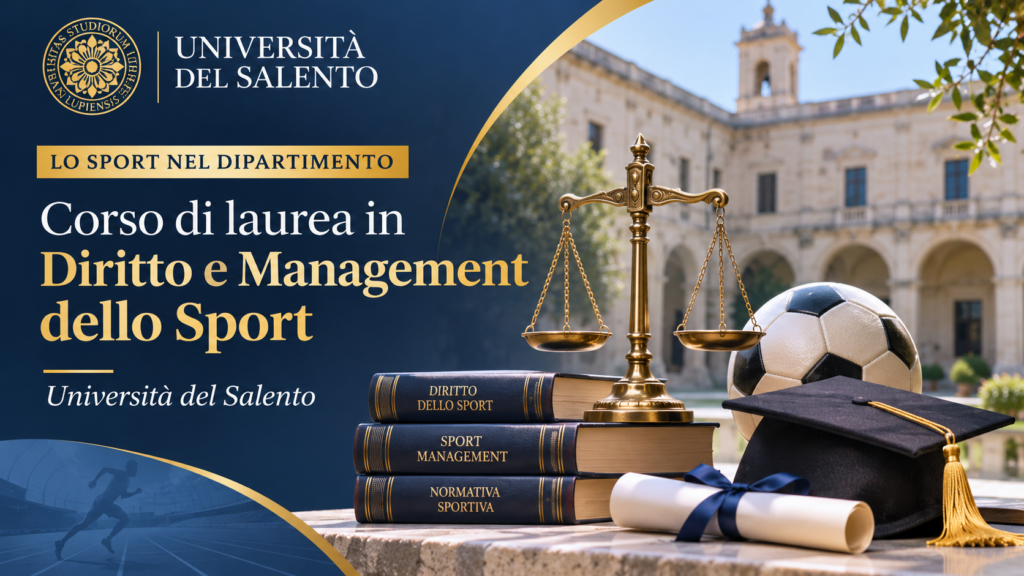
The University of Salento’s three-year Bachelor’s Degree in Sports Law and Management prepares professionals with legal, economic, business and organisational expertise geared towards professional and amateur sport.
The degree belongs to class L-14 R – Legal Services Sciences, lasts three years, comprises 180 ECTS credits, is based in Lecce and has open admission.
The study programme
The programme covers sports law and justice, contracts and player registration, national and international sports governance, management of clubs and sporting events, marketing, communication and digital innovation. It aims to equip graduates to address legal and management issues within the sports sector.
Blended teaching
Teaching is delivered in a blended format: 30% consists of asynchronous lessons on the e-learning platform, while the remaining 70% is made up of synchronous classes, attended on campus or online and recorded through Microsoft Teams.
Regular teaching is complemented by seminars, webinars, meetings and workshops with academics, professionals and representatives of the sports world.
Two curricula
From the 2025/2026 academic year, the degree offers two curricula:
- Legal curriculum: strengthens the grounding in law and, where the statutory requirements are met, allows an early six-month internship towards admission to the state qualifying examination for employment consultants.
- Management and digital curriculum: focuses on running sports organisations, economics and innovation and enables graduates to continue their studies in LM-77 Master’s Degree programmes in Business Management.
Career opportunities
Graduates can work with sports clubs and associations, federations, sports promotion bodies, public and private organisations, businesses in the sector, and organisations that plan and run events.
Professional opportunities identified in the programme include administrative and technical roles, athlete agents and representatives, event and sports-facility organisers, and sports scouts.